
The Real Problem Nobody Warns You About
Translating a book with AI sounds straightforward: upload the file, pick the target language, wait for the output. The problem is that most general-purpose translation tools — DeepL, Google Translate, ChatGPT — treat each paragraph or text block in isolation.
For short documents, this works fine. For a 300-page novel, it creates problems you only notice when you think you're done:
- A character named "John" in Chapter 3 who becomes "Jonathan" in Chapter 15
- Technical or cultural terms translated differently in different parts of the book
- The narrator's tone shifting between chapters because the model updated its "interpretation" along the way
- The author's recurring phrases or stylistic tics disappearing or changing unpredictably
The result is a translation that is technically correct sentence by sentence, but loses the coherence and style that make a book feel like a unified work.
Why DeepL and Google Translate Aren't Enough for Books
DeepL is an excellent tool for what it's designed to do: translate text fragments with high linguistic accuracy. But it has two fundamental limitations for literary or long-form translation:
1. It doesn't read the whole book before translating DeepL processes text in chunks. It doesn't have access to the complete book context when it translates the first chapter. This means early translation decisions aren't informed by what comes later — which matters enormously in fiction and narrative non-fiction.
2. No persistent glossary Professional translators build a glossary before they start — proper nouns, world-specific terms, the author's characteristic expressions. DeepL doesn't do this automatically, so consistency isn't guaranteed across a full-length work.
For short texts, these limitations are invisible. For a book, they're fundamental.
The Right Approach: Read the Book Before Translating
The difference between a high-quality book translation and a mediocre one is the same whether you're using a human translator or an AI tool: you need to read — or analyse — the entire book before translating a single word.
A good human translator reads the full manuscript before writing anything. This lets them:
- Identify characters and their speech patterns
- Understand the central themes and the author's register
- Build the glossary of terms that must remain consistent
- Make coherent decisions about cultural references
AI tools built specifically for book translation replicate this process:
- Full document analysis: before translating anything, the system processes the entire book to identify characters, terminology, tone, and recurring elements
- Glossary construction: an automatic translation glossary is created for all terms that need to be handled consistently throughout
- Chapter-by-chapter translation with global context: each chapter is translated with access to the glossary and the full-book analysis as a constant reference
- Coherence review: a final pass verifies that critical terms are consistent from first page to last
Types of Books That Benefit Most
Fiction and literary work Literary translation is the most demanding case: the author's style, character voices, cultural references, and metaphors all require absolute consistency. With the right AI tool, a 300-page novel can be translated in 10–20 minutes while preserving the author's distinctive voice.
Non-fiction and essays Business books, self-help, popular science, and essays are excellent AI translation use cases. Terminology is more standardised and terminological consistency is critical.
Technical manuals and documentation Product manuals, technical documentation, and textbooks are ideal candidates for AI translation. Precision and consistency matter more than literary style, which plays to AI's strengths.
Academic books and textbooks Texts with field-specific terminology translate well, provided the tool handles footnotes and bibliographies properly.
Practical Workflow
Step 1: Prepare your file Most tools accept PDF and Word (.docx). If your book is in another format (ePub, plain text), convert it first. The quality of the source file directly affects translation quality.
Step 2: Choose your language pair Specify the source language and target language. The best tools support over 15 target languages, with particularly strong quality for major European language pairs.
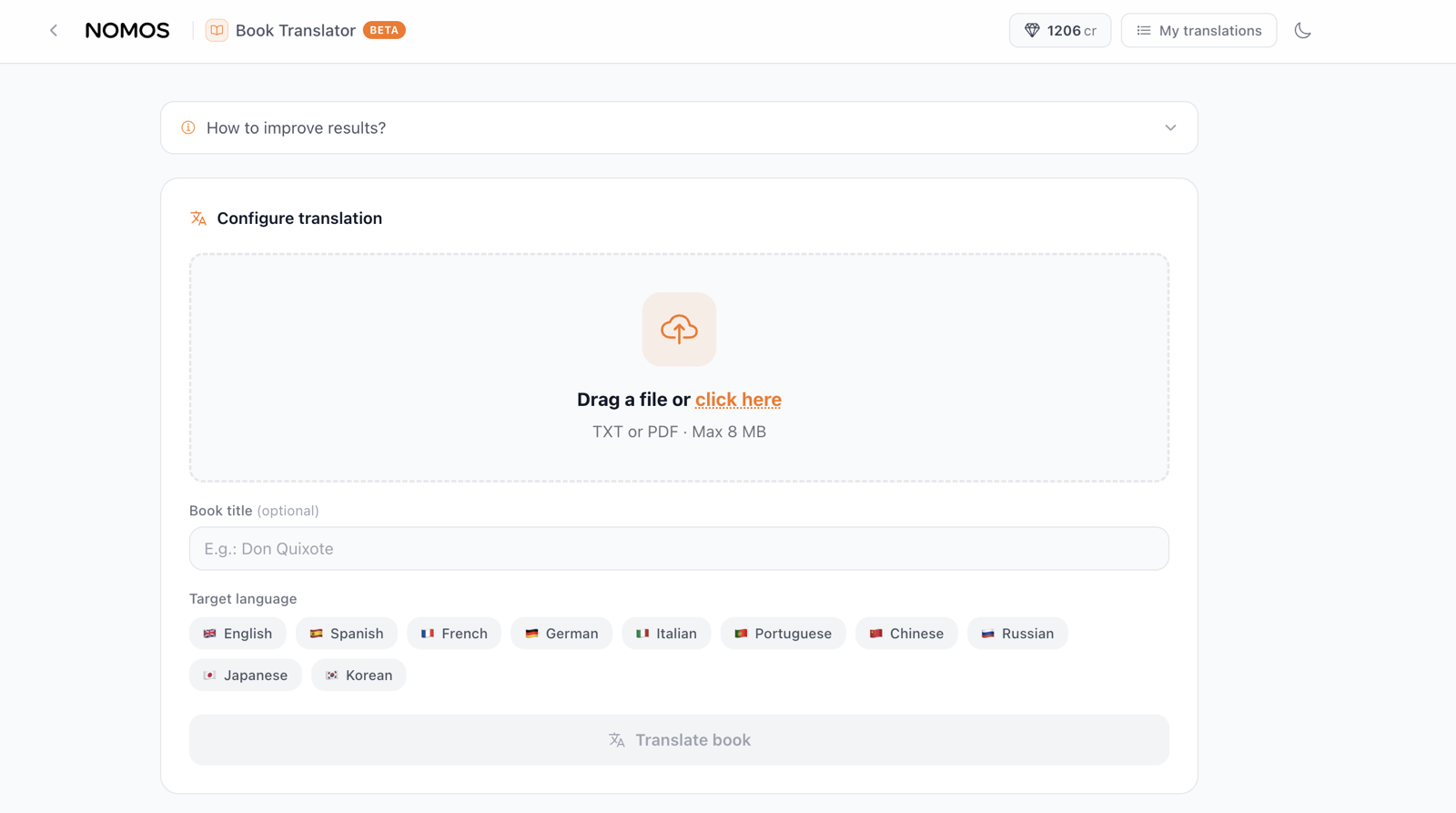
Step 3: Review the generated glossary (optional) Some tools display the auto-generated glossary before translating. If there are terms you want translated in a specific way — proper names you want kept in the original, technical terms with established translations — this is the moment to specify them.
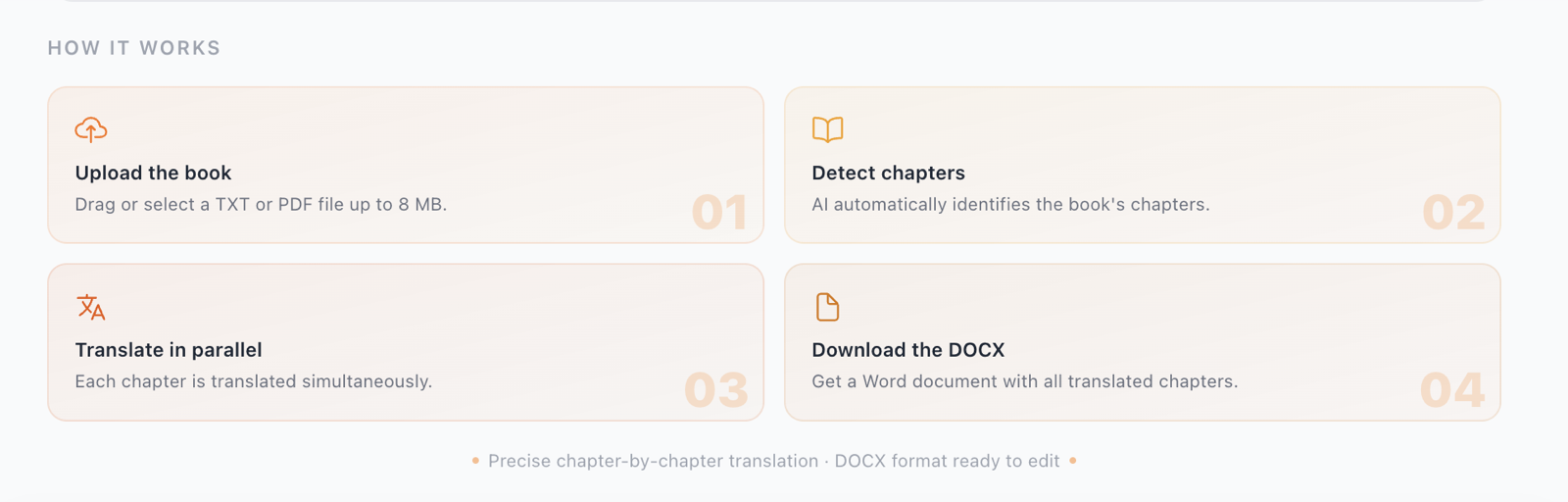
Step 4: Generate the translation The translation process runs in parallel: multiple chapters are processed simultaneously. A 200-page book can be translated in 2–15 minutes depending on the model and target language.
Step 5: Review and edit Output arrives in Word, ready to edit. Reviewing an AI translation is significantly faster than translating from scratch — especially for non-fiction and technical content.
Speed vs. Quality: Choosing Your Model
Modern specialised translation tools typically offer two modes:
Standard model (faster) Ideal for non-fiction, technical manuals, and texts where linguistic precision matters more than literary style. A 200-page book: 2–5 minutes.
Advanced model (higher literary quality) Better for fiction and essays where the author's voice is paramount. A 200-page book: 10–20 minutes.
For the majority of business and academic use cases, the standard model produces excellent results at a fraction of the time.
Cost Comparison
| Method | Cost (200-page book) | Time | Quality |
|---|---|---|---|
| Professional translator | $2,000–$5,000 | 2–4 weeks | Excellent |
| DeepL Pro | $15–$40 + manual editing | 2–4 hours | Good but inconsistent |
| AI specialist (Nomos) | ~400 credits | 2–15 minutes | Very good with coherence |
Conclusion
Translating a complete book with AI is entirely viable in 2026 — but it requires a tool built for full-length documents, not a generic translation utility. The difference comes down to whether the tool analyses the full book before translating and maintains a consistent glossary throughout the process.
For publishers, freelance translators, and companies with extensive technical documentation, specialised AI book translation tools offer a quality-to-time-to-cost ratio that makes previous approaches look inefficient.