
The Annual Report: Every Organisation Needs It, Nobody Wants to Write It
The annual report is one of the most important — and most dreaded — corporate documents of the year. Whether it's a management report for shareholders, a sustainability disclosure under GRI standards, an integrated report, or a board-facing activity summary, these documents share the same defining characteristics: they're long (typically 80 to 200 pages), they must be on-brand (tone, headers, and format should align with previous years), and they have an immovable deadline (the financial year closes whether you're ready or not).
AI is transforming how organisations produce these documents. Here's what you need to know to implement it in your team.
What to Gather Before You Use AI
The most common mistake when attempting to generate an annual report with AI is expecting the tool to fabricate data. No serious tool does that — nor should it.
What AI can do is convert your existing information into a structured, coherent, well-written document. To get there, you need to assemble:
Reference documents:
- Last year's annual report (as the structural and tonal benchmark)
- Your corporate Word templates with brand headers, fonts, and colour guidelines
Year's data:
- Financial results (P&L, balance sheet, cash flow)
- Key operational metrics by business unit
- ESG indicators if applicable: emissions, energy consumption, waste management, water usage
- Headline initiatives and projects from the year
- People data: headcount, diversity metrics, training hours, turnover
- Any significant incidents and how they were managed
Key messages:
- The 3–5 messages leadership wants this report to convey
- Your strategic positioning for the year ahead
With these materials in hand, a specialised AI tool can generate the report draft in minutes rather than weeks.
The Step-by-Step Process
Step 1: Load the previous report as your style reference
Most AI tools for corporate documents let you upload a reference document. By uploading last year's annual report, the AI learns your organisation's tone, chapter structure, domain-specific terminology, and formatting conventions.
The result is a new report that sounds like you — not like generic AI output that reads as if it came from a template.
Step 2: Upload the year's data
Upload your internal presentations, management reports, committee minutes, and any document containing relevant data from the year. The more specific information you provide, the more precise and less generic the output.
Step 3: Define the structure
Specify whether the report follows GRI (for sustainability disclosures), TCFD (for climate-related financial disclosures), CSRD requirements, a proprietary company format, or an industry-standard structure. The AI will build the chapter outline accordingly.
Step 4: Generate and review by section
The AI generates chapters while maintaining coherence across the full document. Review is faster because you're correcting a solid draft rather than building from a blank page.
Step 5: Approval circuit
The draft enters your usual approval process: communications, legal, executive leadership. With AI, this draft is typically ready weeks earlier than usual — giving reviewers more time and reducing last-minute pressure.
Concrete Benefits for Your Team
Time savings: from weeks to days A communications or sustainability team typically spends 4–8 weeks drafting an annual report. With AI, that draft can be ready in 1–2 days, freeing up more time for review and strategic sign-off.
Consistent tone and format One of the most common pain points in reports assembled across multiple departments is stylistic inconsistency. When AI generates the complete draft using the previous report as a reference, tone is uniform from cover to cover.
Fewer revision rounds A well-structured first draft reduces the number of iterations with reviewers. They focus on adjusting substance rather than fixing structure or rewriting for style.
Process documentation AI tools for corporate documents maintain a history of generated versions and the input documents used. This is valuable for audit purposes and for streamlining the following year's process.
Sustainability Reports Specifically
Sustainability disclosures have framework-specific requirements depending on which standard your organisation follows (GRI, SASB, TCFD, CSRD). AI is particularly valuable here because:
- It understands the indicator requirements of each reporting framework
- It can automatically structure emissions, water, waste, and diversity data according to the chosen standard's disclosure requirements
- It maintains consistency between quantitative indicators and the narrative text that accompanies them
For companies reporting under CSRD (the EU's new corporate sustainability reporting directive), the volume and specificity of required disclosures make AI assistance less of a convenience and more of a practical necessity.
What to Look for in a Tool
Not every AI tool is suited to corporate reporting. The critical criteria:
Ability to process reference documents The tool must be able to read and use your previous annual report and brand template as style references. This is non-negotiable for brand consistency.
Document length capacity A 150-page annual report needs a tool that handles long documents without losing coherence. General-purpose tools like ChatGPT are not adequate here.
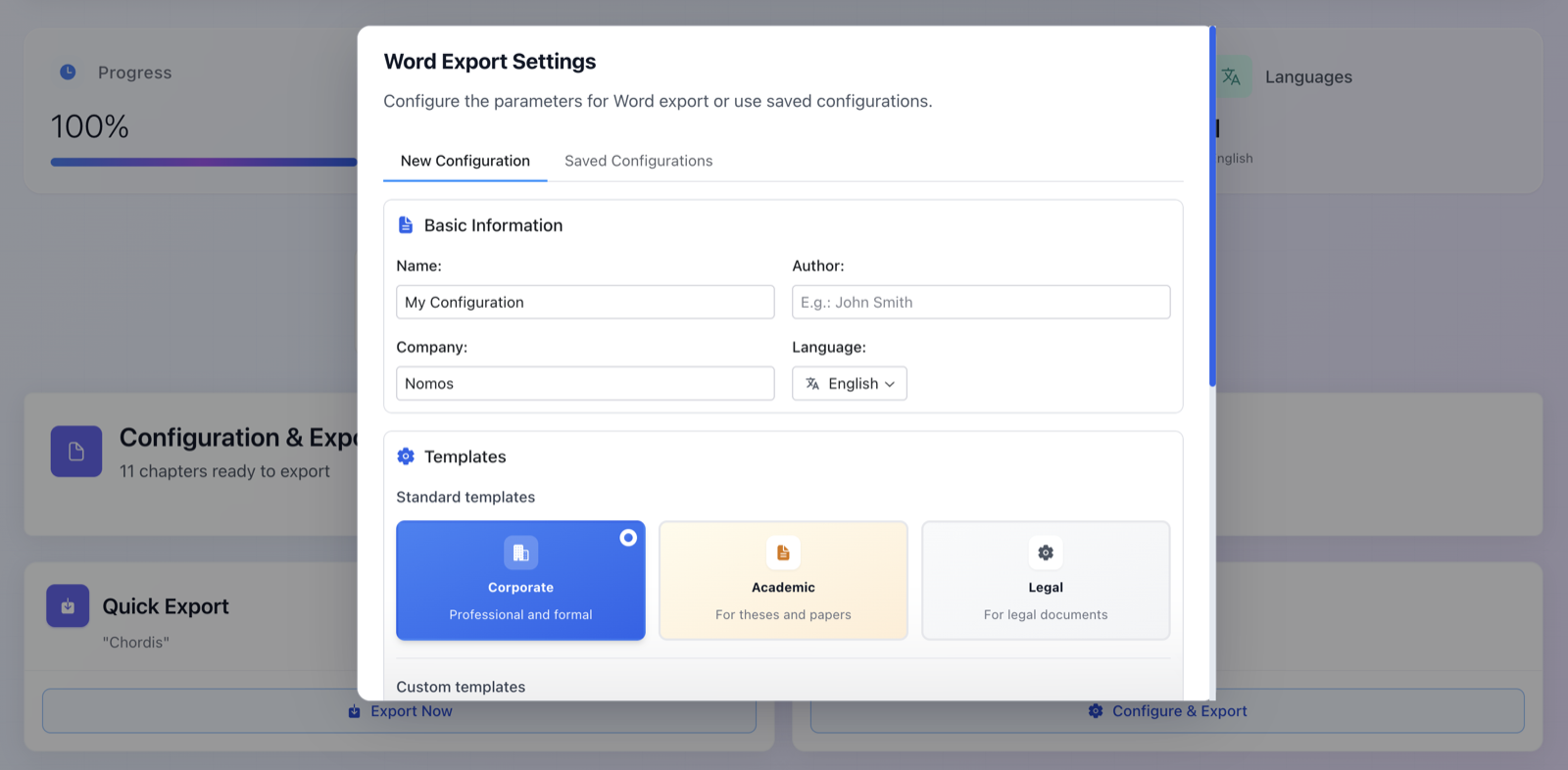
Word export with correct formatting The draft must come out in an editable format that respects your corporate template's headers, fonts, and colour scheme.
Data security Financial and strategic data in an annual report is confidential. Verify that the tool does not use your documents to train its models and that data processing meets your organisation's security requirements.
Conclusion
AI-assisted annual reporting isn't a near-future concept — it's something corporate teams across the US, UK, and Europe are actively adopting right now. The process is faster, the draft is more consistent, and the team can focus on strategic review rather than writing from scratch.
The key to success is preparation: the more reference material and specific data you provide, the more precise and useful the output will be. Garbage in, garbage out still applies — but with quality inputs, the results are genuinely impressive.