
AI Has Changed the Thesis Game — But Not How You Think
For most students, writing a thesis is the single most demanding task of their academic career. Not because the knowledge isn't there — by the time you're writing it, you know your field better than ever — but because turning that knowledge into 80, 100, or even 200 coherent pages feels like an impossible mountain to climb.
AI has genuinely changed this. But the change isn't what most students expect: it's not about having AI write your thesis for you. It's about using AI to structure, develop, and maintain the coherence of a document that no student could produce with the same speed and consistency working manually.
This guide walks you through the right approach in 2026, what tools to use, and why most students are using AI wrong for their academic work.
What AI Can (and Can't) Do for Your Thesis
Before jumping into the process, it's worth being honest about what today's tools actually do well.
Where AI genuinely excels:
- Generating chapter structures and section outlines from your topic and sources
- Writing sections in appropriate academic register
- Maintaining consistent terminology throughout a 100+ page document
- Adapting tone to your discipline (engineering, humanities, social sciences, law)
- Integrating your bibliography in a coherent way
- Exporting to Word with formatting ready to submit
What AI doesn't replace:
- Your judgment as a researcher when evaluating sources
- The originality of your own conclusions
- Critical review of the data you feed in
- Ethical assessment of your arguments and methodology
The most common mistake is expecting AI to "invent" the thesis from scratch. The result is generic, shallow text that plagiarism detection systems flag instantly. The right approach is to use AI to scale your own knowledge: you bring the sources, the data, the angle; AI turns them into a structured, coherent document.
Step 1: Gather Your Sources Before You Start
The number-one mistake when using AI for a thesis is starting without sources. An AI without real input can only produce generic text.
Before generating anything, prepare:
- Academic papers relevant to your topic (Google Scholar, JSTOR, Scopus, PubMed depending on your field)
- Books or book chapters that are core references in your area
- Your own data if your thesis includes empirical work (surveys, experiments, interviews, datasets)
- Legislation or regulations for law, public policy, or compliance-heavy fields
- Technical documentation for engineering or computer science theses
The more quality sources you provide, the more specific and credible the output. Specialized AI tools like Nomos let you upload these documents directly and use them as a knowledge base when drafting each chapter — meaning every claim is grounded in your actual sources, not hallucinated.
Step 2: Define Your Thesis Structure
A well-structured thesis follows a recognizable pattern, though it varies by discipline. The most common structure in humanities and social sciences:
- Title page and table of contents — auto-generated
- Abstract — 250–300 words
- Introduction — rationale, objectives, hypotheses, methodology overview
- Literature review — state of the art
- Methodology — research design, sample, instruments, procedure
- Results — data analysis
- Discussion — interpretation in the context of existing literature
- Conclusions — answers to objectives, limitations, future directions
- Bibliography — in your required format (APA, MLA, Chicago, Vancouver)
- Appendices — supporting materials
In STEM fields, the structure typically also includes design, implementation, and validation sections.
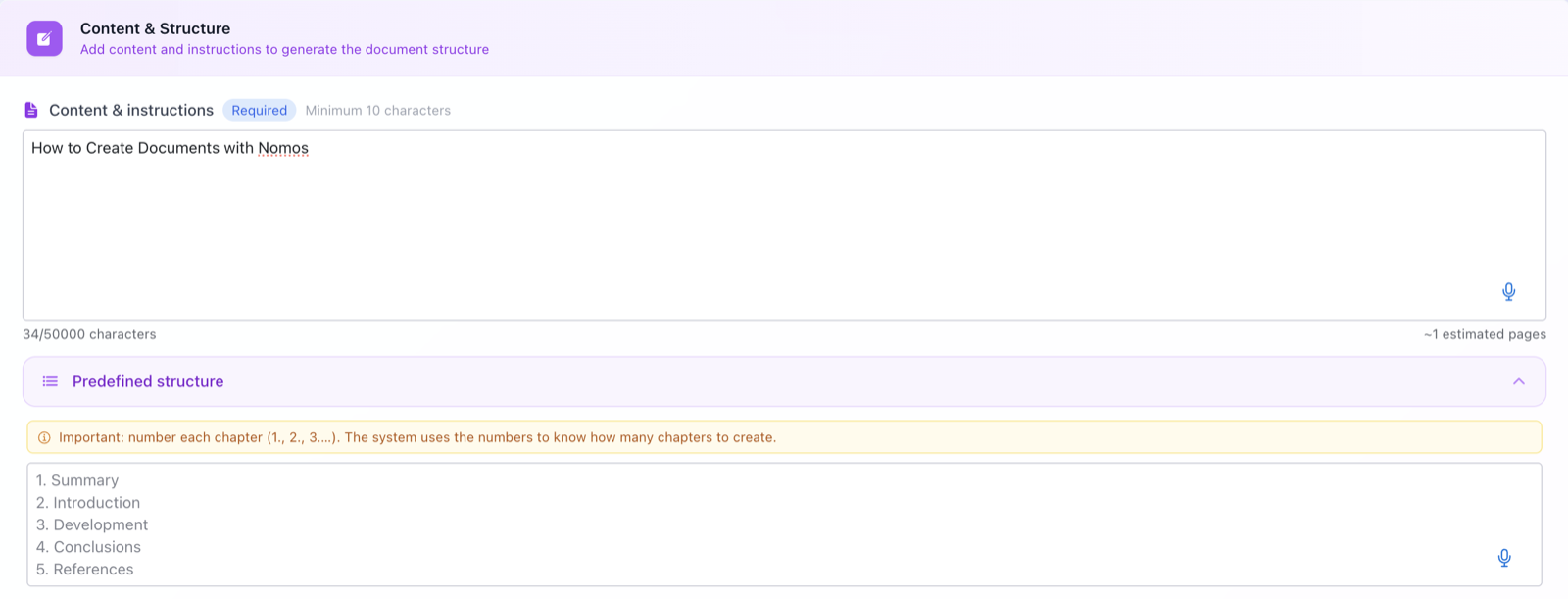
When working with a tool like Nomos, you define this structure upfront and the AI adapts each chapter's content to fit it — without repetition or contradictions between sections.
Step 3: Generate with Cross-Chapter Coherence
This is where most AI tools fall short. ChatGPT, for example, has a context window that prevents it from accurately "remembering" what it wrote in Chapter 2 when it's drafting Chapter 5. The result: texts that contradict themselves, repeat concepts, or shift terminology without reason.
Tools built specifically for long documents solve this with multi-agent architectures: one agent extracts key themes from your sources, another maintains the "thread" of the full document while writing agents work in parallel on each chapter.
The practical result: a 200-page thesis generated in 5–10 minutes where the introduction introduces concepts developed in the literature review, which in turn are reflected in the discussion of results. The document reads like it was written by a single, focused author.
Step 4: Review and Personalize
AI produces a high-quality draft — not a finished, submission-ready document. After generating your thesis, you should:
- Read each chapter and verify that information is accurate and sources are correctly cited
- Add your own thinking in the discussion and conclusions sections — this is what separates a pass from a distinction
- Adjust the tone where sections feel too generic or don't match your voice
- Check formatting against your institution's style guide
- Verify the bibliography to confirm every citation is present and correctly formatted
The Word export makes this review process straightforward — you can edit directly and incorporate supervisor feedback without any friction.
Step 5: Final Submission Prep
With your Word document ready, the last step is adapting formatting to your institution's requirements:
- Margins, line spacing, and font (typically 1-inch margins, double or 1.5 spacing, Times New Roman 12pt or Arial 11pt)
- Page numbering starting from the introduction
- Title page with your institution's specific fields
- Headers and footers with your title and student ID
Many AI thesis tools allow you to upload your institution's Word template so the document comes out pre-formatted from the start — saving you the formatting step entirely.
Tool Comparison: AI for Thesis Writing in 2026
| Tool | Cross-Chapter Coherence | Max Pages | Your Own Sources | Exports to Word |
|---|---|---|---|---|
| ChatGPT | Low (loses context) | ~20 pages | Limited | Not directly |
| Claude | Medium | ~50 pages | Yes (file uploads) | Not directly |
| Nomos | High (multi-agent) | 200+ pages | Yes (PDF, Word, images) | Yes |
FAQ: Using AI for Your Thesis
Is it legal to use AI for my thesis? It depends on your institution's policy. Most universities now permit AI as a support tool as long as students demonstrate genuine understanding of the content. What's generally prohibited is submitting AI-generated text without meaningful review or contribution. Always check with your supervisor.
Will plagiarism detectors flag AI-generated text? Tools like Turnitin have AI detection modules, but their false positive rate is significant. The best strategy: review and personalize the generated text so it genuinely reflects your knowledge and voice.
How much does it cost to generate a thesis with AI? Nomos uses a credit system. You can start with free credits to see the output before committing.
Conclusion
Writing your thesis with AI in 2026 isn't cheating — it's using available tools intelligently. The key is providing the knowledge and sources yourself, letting AI handle the structure and coherence, and then reviewing the output to add your personal stamp.
The thesis you submit is still yours. AI just helps you write it faster and better.