
The Question Every Student Is Asking
"Can I use ChatGPT to write my thesis?" It's probably the most Googled academic question of 2026. The honest answer: yes, for specific tasks — but with significant limitations most students only discover when it's too late.
This article breaks down what ChatGPT genuinely does well for thesis work, where it falls apart, and when you need a more specialized tool.
What ChatGPT Does Well for Your Thesis
To be fair: ChatGPT is an extraordinarily useful tool for several specific thesis tasks.
1. Brainstorming Structure Ask ChatGPT to suggest five possible chapter structures for your thesis on a given topic. You'll get useful options in seconds. It's an excellent starting point before your first meeting with your supervisor.
2. Rewriting and Improving Paragraphs You've written a paragraph but it sounds clunky or informal. Paste it into ChatGPT and ask it to rewrite in an academic register. It works very well for individual sections.
3. Summarizing Academic Papers Upload a paper (on paid plans with file capabilities) and ask for a five-point summary. Useful for rapidly moving through a reading list.
4. Generating Discussion Points "Given these findings, what practical implications could I include in my discussion chapter?" ChatGPT can suggest angles you hadn't considered.
5. Grammar and Style Checking As a style editor, ChatGPT is genuinely competent. For polishing final prose, it's a reliable assistant.
Where ChatGPT Fails: The Long Document Problem
Here's the real issue. A thesis isn't five pages — it's 60, 80, 100, or 200 pages depending on your program. And ChatGPT has a context window that makes it practically useless for documents of that length.
What is a context window?
The "context window" is how much text ChatGPT can "remember" within a conversation. Even though newer models have large windows, in practice this means that when you ask it to write Chapter 4, it no longer has precise recall of what it wrote in Chapter 1.
The practical consequences for your thesis:
- Terminology shifts between chapters (what's called "participants" in Chapter 2 becomes "subjects" in Chapter 5)
- Key definitions get repeated as if they were never introduced
- Cross-references between chapters are wrong or nonexistent
- The theoretical framework doesn't properly connect with the methodology
- Conclusions don't clearly answer the hypotheses stated in the introduction
The result: you end up reviewing and correcting so much that the time saved disappears into repairs.
The Realistic ChatGPT Thesis Workflow
Most students who try to use ChatGPT for their full thesis end up with something like this:
- Ask for the introduction → good
- Ask for the literature review → acceptable, somewhat generic
- Ask for the methodology → starts to disconnect from the rest
- Ask for results → it doesn't have access to their actual data
- Ask for discussion → generic, doesn't connect to their specific theoretical framework
- Ask for conclusions → roughly correct but lacks narrative arc back to the introduction
After all that, the student has a collection of chapters that need to be stitched together, inconsistencies corrected, transitions rewritten, and every bibliographic reference verified for accuracy. That's hours of work.
When ChatGPT Makes Sense for Your Thesis
With these limitations clearly laid out, ChatGPT remains useful in specific contexts:
- Short theses (under 30 pages): the context window is sufficient to maintain reasonable coherence
- Isolated sections: correcting, rewriting, summarizing individual pieces
- Pre-writing tasks: brainstorming, initial structure, identifying research angles
- Final polish: improving style and grammar on an already-structured text
When You Need a Specialized Tool
If your thesis exceeds 40 pages, or if you need a genuinely cohesive document where each chapter connects with the last, you need a tool designed specifically for long documents.
The key differences from ChatGPT:
- Multi-agent architecture: instead of one model with limited context, multiple agents work in parallel while maintaining a "through-line" for the complete document
- Your own knowledge base: you upload your sources (PDFs, Word files, images) and the AI uses them to generate specific, grounded content rather than generic text
- Guaranteed structural coherence: the introduction, methodology, and conclusions are drafted in a coordinated way
- Direct Word export: formatted and ready to submit or hand to your supervisor
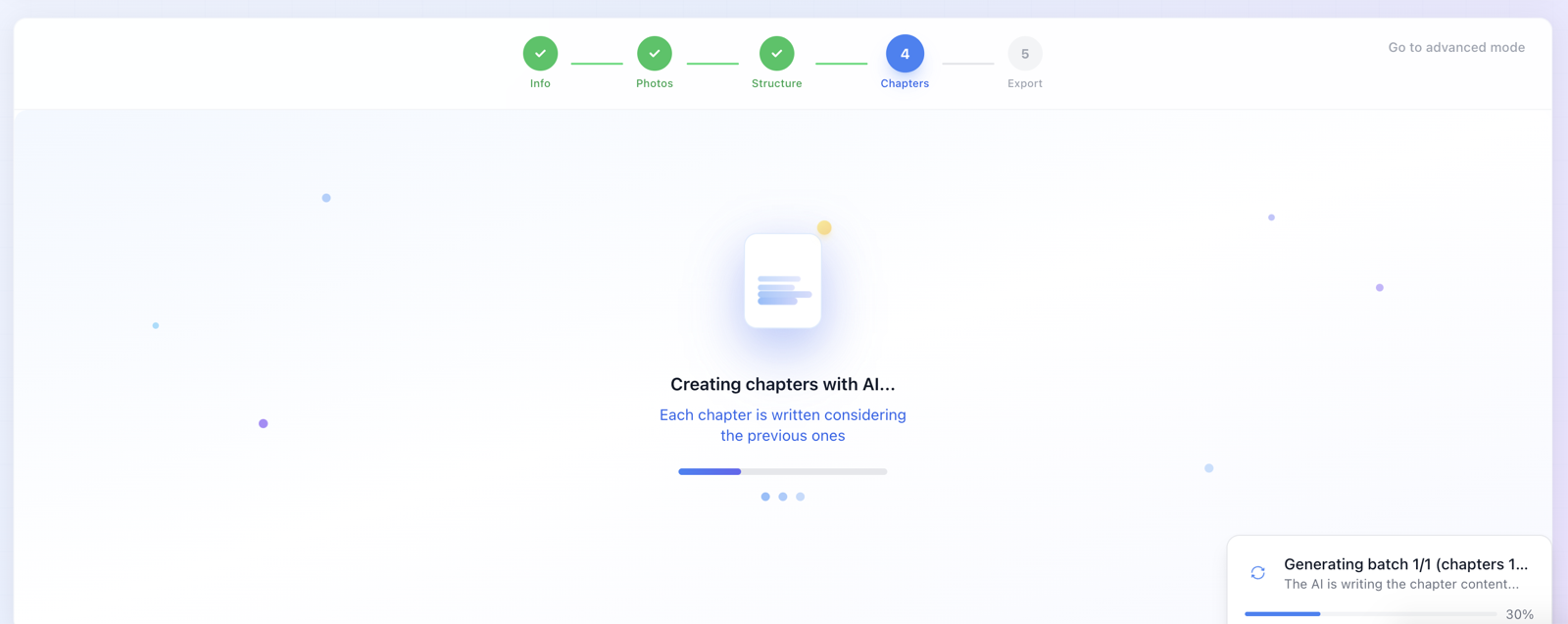
Tools like Nomos are built specifically for this use case — theses, dissertations, and long corporate documents — and solve the coherence problem that ChatGPT cannot overcome by design.
Conclusion: ChatGPT Is Useful, But Not Enough for a Full Thesis
ChatGPT is an excellent Swiss Army knife for specific tasks, but it wasn't designed to generate long, cohesive academic documents. If your thesis runs over 40 pages, you need a specialized tool that maintains coherence from start to finish.
The good news: with the right tools, a 100-page thesis can be structured and drafted in under 10 minutes. What remains is review, personalization, and your own intellectual contribution — which is, ultimately, the part that's genuinely yours.