
When a General-Purpose AI Stops Being Enough
The large language models available today — ChatGPT, Claude, Gemini — have genuinely democratised assisted writing. For emails, summaries, short articles, and one-off tasks, they're extraordinary.
The problems start when the document exceeds 20–30 pages. That's where these models run into structural limits that no amount of prompting can overcome. Understanding those limits is the starting point for choosing the right tool.
This guide analyses what's actually available in 2026 for long-document work, what each tool's real strengths are, and when a specialised tool makes more sense than a general-purpose model.
Technical Background: Context Windows and Coherence
To understand the differences between tools, you need to understand the concept of the context window: the maximum amount of text a model can process in a single interaction.
| Model (as of mid-2026) | Context Window | Approx. Pages It Can Read |
|---|---|---|
| ChatGPT — GPT-5.6 | ~1,050,000 tokens | ~800 pages |
| Claude — Opus 4.8 / Sonnet 4.6 | 1,000,000 tokens | ~750 pages |
| Gemini — 3.5 Pro | 2,000,000 tokens | ~1,500 pages |
| Gemini — 3 Pro (web/app) | 1,000,000 tokens | ~750 pages |
Here's the plot twist for 2026: the context window is no longer the bottleneck. Two years ago the flagship models topped out around 128k tokens (~96 pages); today every major model can read a whole book in one pass. If all you need is to read a 300-page PDF and ask questions about it, almost any 2026 frontier model handles it comfortably.
The bottleneck moved. It's now about authoring — writing a coherent 100–200 page document — where two problems bite regardless of how big the window is:
-
Degradation deep in the window ("lost in the middle"): a model can hold a million tokens but doesn't reason uniformly across all of them. Content in the middle of a very long context is weighted less, so details from chapter 2 quietly get dropped by chapter 18.
-
No enforced coherence in single-pass generation: fitting the whole job into one window doesn't make the model keep section 12 consistent with section 3. One long generation has no mechanism to enforce a fixed outline, stable terminology, or hypotheses that get answered in the conclusion.
Specialised tools attack the authoring problem with multi-agent architectures: instead of one long prompt, they plan the outline first and then generate section by section against a shared, persistent global context — the thing a single chat window can't guarantee.
General-Purpose Models: Honest Analysis
ChatGPT — GPT-5.6 (OpenAI) · ChatGPT Plus $20/mo
Strengths:
- Excellent writing quality across most registers and styles
- A ~1M-token window (as of mid-2026) means it can now read a whole book at once
- Strong comprehension of complex, multi-part instructions
- Familiar interface with a low learning curve
Limitations for long documents:
- A big window doesn't buy coherence: across a 150-page single-pass draft it still forgets earlier sections and repeats itself
- You have to manually manage the outline (pasting summaries, re-establishing scope on every revision)
- No native way to upload 15 sources and have them integrated into one structured, cross-referenced document
- Word export is basic and usually needs reformatting
Best for: drafting individual sections up to ~30–40 pages that you assemble and reconcile yourself; ideation and editing.
Claude — Opus 4.8 / Sonnet 4.6 (Anthropic) · Claude Pro $20/mo
Strengths:
- 1M-token context window in 2026 (Anthropic dropped long-context surcharges in March 2026)
- Arguably the strongest at analysing long documents and extracting structured information
- Excellent reasoning across extended texts; consistently strong prose
- Handles large single files well for reading and Q&A
Limitations for long documents:
- No native export to a formatted Word document with cover, index and pagination
- No persistent glossary or style memory across separate generation sessions
- No document-specific architecture: it writes what you ask section by section, but won't itself plan and enforce a 150-page structure
- You are still the "editor agent" keeping chapters consistent
Best for: analysing existing documents, drafting long individual sections with heavy prior context, reviewing and tightening drafts.
Gemini — 3 Pro / 3.5 Pro (Google) · Google AI Premium ~$20/mo
Strengths:
- The largest context window in production: up to 2M tokens on 3.5 Pro (~1,500 pages)
- Reads very long PDFs directly, including tables and images
- Integrated with Google Workspace (Docs, Drive)
- Strong multimodal capabilities (text + images together)
Limitations for long documents:
- Formal prose is competitive, but the "lost in the middle" effect is still visible on very long windows
- No chapter-level coherence enforcement for separately generated sections
- Output formatting is basic; no submission-ready export
- Superb at reading a 1,000-page corpus; still not built to author a coherent 200-page one
Best for: analysing huge PDFs and multi-document corpora, Google-integrated workflows, multimodal reading.
NotebookLM (Google) · free; Plus from $7.99/mo
Strengths:
- Purpose-built for grounded Q&A over your sources: it answers only from what you upload, with citations, which keeps hallucination low
- Generous ingestion — 50 sources per notebook on the free tier (up to 500+ on paid), and 500,000 words per source on every tier
- Excellent for research synthesis, study guides, and audio overviews
Limitations for long documents:
- It's a reading and synthesis tool, not a long-form author: it won't produce a structured 150-page manuscript
- Output is notes, summaries and answers — not a formatted, exportable deliverable
- No cross-chapter authoring, no Word export with cover and pagination
Best for: understanding and querying a large body of sources before you write — not producing the finished document.
Jenni AI · Unlimited from $12/mo (annual)
Strengths:
- Academic-writing focused: inline autocomplete, in-text citations, and reference management
- Good for pushing through the blank page paragraph by paragraph
- PDF chat and citation insertion built in; exports to Word
Limitations for long documents:
- It assists your sentence-by-sentence writing; it does not plan and generate a whole coherent thesis end to end
- Coherence across 100+ pages is still your job
- Not designed for corporate reports, RFP responses, or full-book translation
Best for: students writing academic prose who want AI autocomplete and citation help while staying in control of the draft.
Specialised Tools: When They Have a Clear Advantage
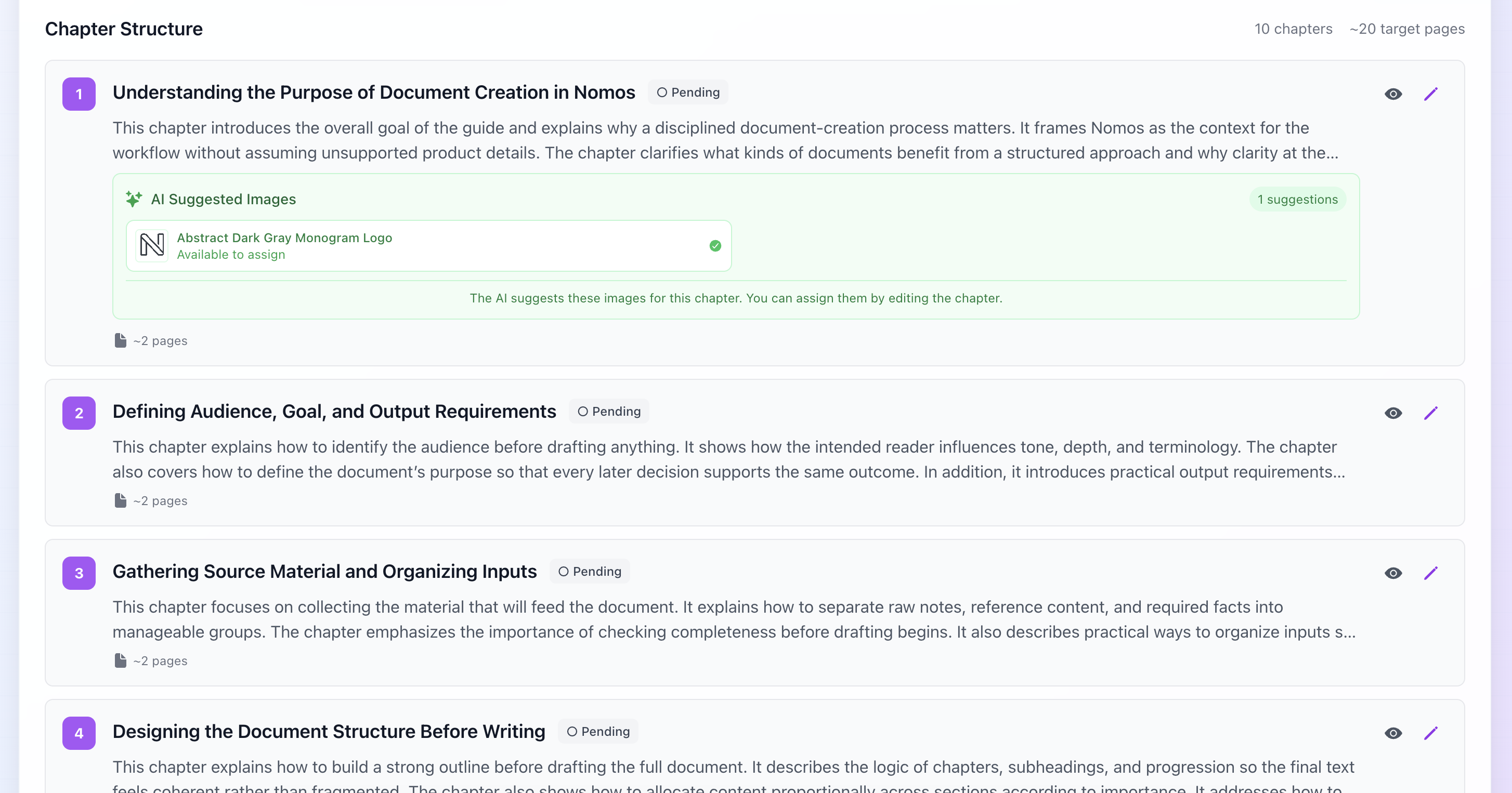
Tools built specifically for long documents (like Nomos) use a fundamentally different architecture from general-purpose chatbots.
How Multi-Agent Architecture Works
Instead of a single conversation, the process is divided into phases:
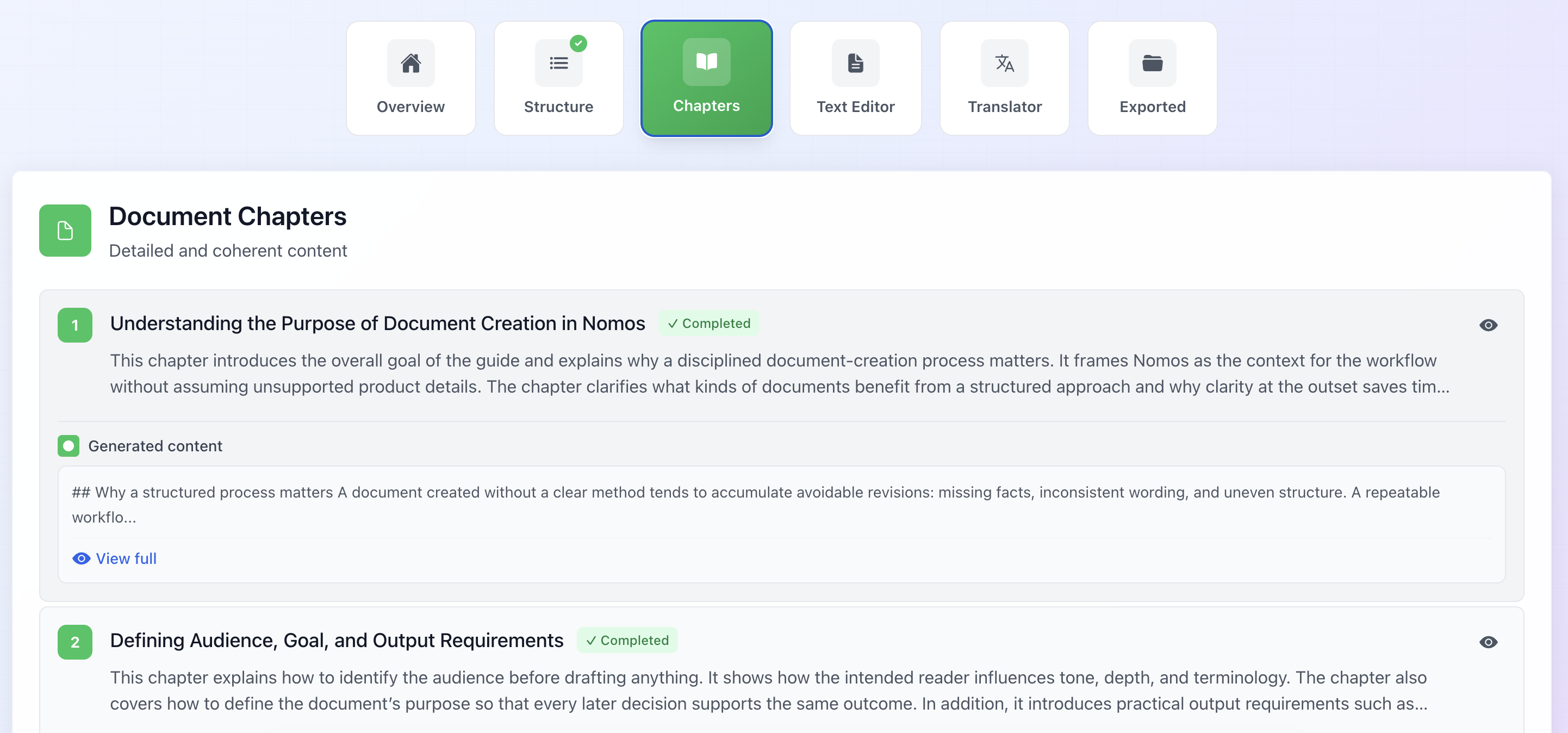
- Analysis: the system reads all sources you upload and builds a map of concepts, terminology, and document structure
- Planning: a complete document outline is generated before any section is written
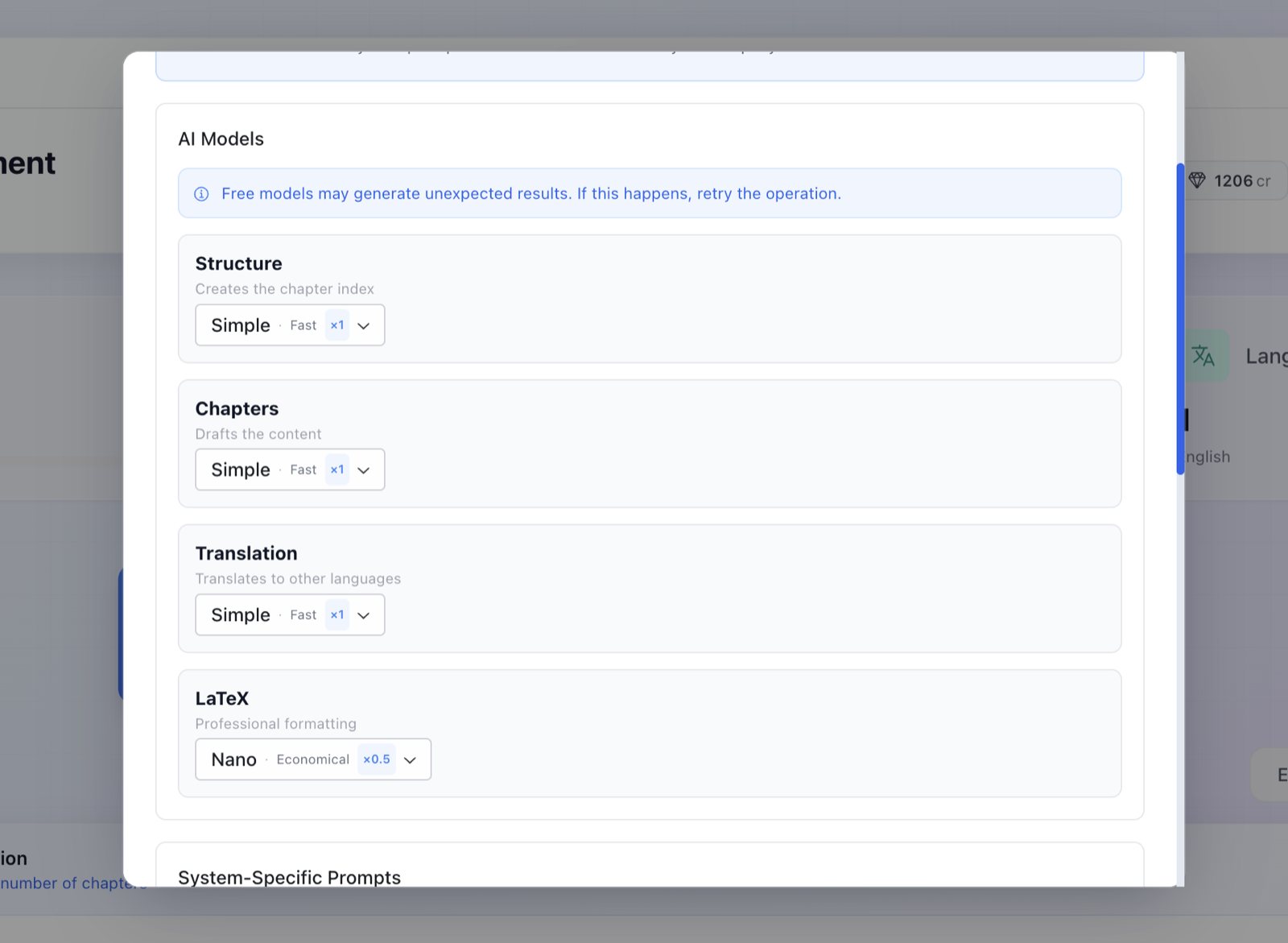
- Parallel generation: multiple specialised agents write chapters simultaneously — but all with access to the same global context
- Active coherence checking: an "editor" agent ensures terminology and tone are consistent throughout the full document
This resolves the two main problems of general-purpose models: cross-chapter coherence and multi-source integration.
Use Cases Where Specialised Tools Win Clearly
Theses and dissertations: Academic structure requires each section to explicitly reference preceding ones. The introduction's hypotheses must be answered in the conclusions; the theoretical framework must connect directly to the methodology. A general-purpose model can't do this automatically when sections are generated in separate sessions.
Annual reports and corporate documents: Brand identity requires tonal consistency across 150 pages. The previous year's report must serve as the stylistic reference. A general-purpose model doesn't remember the previous report unless you paste it in full with every prompt.
Technical manuals: Terminology must be perfectly consistent. In a 200-page manual, a term that appears 80 times must be used identically in every instance. This is exactly the kind of constraint multi-agent systems are built to handle.
Book translation: Characters, locations, and the author's voice must be preserved from page 1 to page 400. A model that translates fragment by fragment simply cannot guarantee this.
The Tools at a Glance (as of mid-2026)
| Tool | Context window | Pages it can read | Authors a coherent 150-pg doc? | Word export | Price (consumer plan) |
|---|---|---|---|---|---|
| ChatGPT (GPT-5.6) | ~1.05M tokens | ~800 | No — drifts in one pass | Basic | $20/mo (Plus) |
| Claude (Opus 4.8) | 1M tokens | ~750 | No — you edit for coherence | No native | $20/mo (Pro) |
| Gemini (3.5 Pro) | 2M tokens | ~1,500 | No — reads great, doesn't author | Basic | ~$20/mo (AI Premium) |
| NotebookLM | 500k words/source | ~1,000+ | No — synthesis, not authoring | No | Free / $7.99+ |
| Jenni AI | Sentence-level assist | n/a | No — autocomplete, you drive | Yes (.docx) | $12–20/mo |
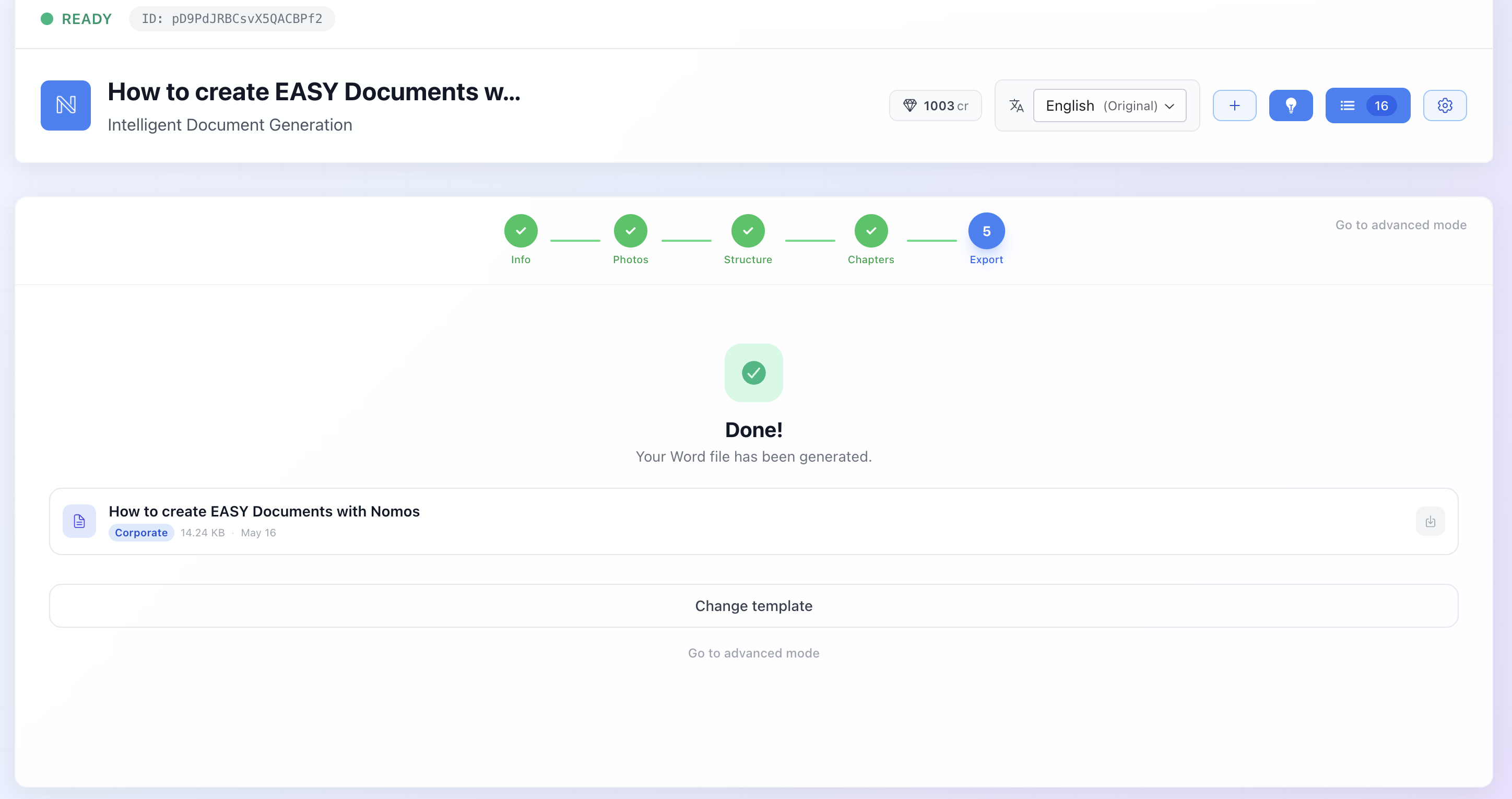
| Nomos | Multi-agent, per-section | 200+ | Yes — plans, generates & checks | Yes, formatted | Credits, one-time |
Prices are consumer/list plans as of mid-2026 and change often; context windows are the vendors' stated maximums. Page counts assume ~1,300 tokens per page.
The same picture, by use case:
| Use Case | ChatGPT / Claude / Gemini | NotebookLM | Jenni | Nomos |
|---|---|---|---|---|
| Email or short article | Ideal | No | Overkill | Unnecessary |
| Section of 10–20 pages | Good | Reference only | Good | Optional |
| Reading / querying a 300-pg PDF | Good | Ideal | Marginal | Not its job |
| Thesis / dissertation (80–150 pages) | Manual, drifts | Research only | Assist only | Built for it |
| Corporate report / RFP (150 pages) | No | No | No | Built for it |
| Book translation (300 pages) | Marginal | No | No | Built for it |
The Pricing Question (2026)
The general-purpose assistants have converged on ~$20/month for their consumer plans — ChatGPT Plus, Claude Pro, and Google AI Premium are all around $20/mo as of mid-2026, with heavier "Max"/Pro tiers at $100–$200. NotebookLM has a free tier (paid from $7.99/mo) and Jenni's Unlimited runs $12–$20/mo. Those flat subscriptions are excellent value for unlimited short tasks.
The catch for long documents is what that $20 actually buys: unlimited chatting, not a finished 150-page deliverable. The real cost is the hours of manual assembly and coherence-fixing you spend stitching sections together. Specialised long-document tools price differently — per credit or per project — so a 100–200 page thesis or report costs a one-time amount (often in the low tens of dollars) with no subscription.
The right comparison isn't $20/mo vs. $20/mo. It's total time and rework to reach a coherent, submission-ready document with each approach.
Where a Specialised Tool Like Nomos Falls Short (An Honest Take)
No tool wins everything, and it would be dishonest to pretend Nomos does. Where a general model is the better choice:
- Short or conversational work. For an email, a two-page memo, brainstorming, or back-and-forth Q&A, Nomos is overkill — open ChatGPT or Claude.
- General versatility. Nomos writes long structured documents. It doesn't do code, data analysis, image generation, or live web search. The $20/mo assistants are far more flexible.
- It drafts; you verify. Nomos generates a structured first draft from your inputs — it won't invent your real data, and every factual claim, citation and number still needs human review before submission.
- Cost scales with length. Credits map to document size. If your work is lots of tiny tasks, a flat monthly assistant is cheaper; Nomos earns its keep on the long, high-stakes documents.
The honest rule: general models for fragments and short tasks; a specialised tool for finishing long documents.
Conclusion
In 2026, general-purpose models are outstanding for writing tasks up to 30–40 pages. For longer documents, the absence of cross-session coherence and global context management makes them unsuitable without significant manual intervention.
Specialised long-document tools don't compete with ChatGPT or Claude on general versatility — they solve a specific problem: coherence at scale. That's exactly the problem that matters when you're writing a dissertation, an annual report, or translating a book.
The right choice depends on document length and type. For short tasks, any major general-purpose model is excellent. For documents over 50 pages with coherence requirements, a specialised tool will save more time than you'd expect — and produce a result that a general-purpose tool, used the same way, simply cannot match.