
Detect the contract.
Generate the proposal.
AI monitors public procurement portals in real time, detects the most relevant contracts for your company based on your criteria, and generates the full technical proposal ready to submit — all from one platform. From weeks of searching and writing to hours.
Automatic monitoring · AI scoring · PDF specs analysed · technical proposal in hours
Nomos vs. the rest of the market
Why no other AI writes the full proposal — they help your team fill answer fields
Comparison compiled by Nomos in July 2026 from each provider's publicly available information. It reflects our own opinion and assessment criteria, not an objective analysis or a third-party verified benchmark; features, prices and timings may have changed since that date. All trademarks belong to their respective owners.
The real cost of an RFP response
Enterprise RFP suites bill a flat annual license — whether you submit 3 bids a year or 30. Nomos bills per proposal. For a small bidding team, that gap is the whole business case.
Even at 24 proposals a year, Nomos costs roughly 3% of a single Loopio license — and you pay nothing in the months you don't bid.
Loopio and Responsive don't publish list prices; the ≈ $22K figure is the reported median annual Loopio contract (Responsive averages ≈ $14K, and both run higher for larger teams). Nomos figures are the one-time credit cost of generating each ~200-page proposal — no mandatory fee, no per-seat licensing.
AI RFP writer vs. ChatGPT: why a chat assistant isn't enough
ChatGPT can brainstorm ideas and polish a paragraph, but it can't turn a raw solicitation into a submission-ready proposal on its own. A government RFP is an 80-to-200-page package with scored evaluation criteria — and three things break down when you rely on a general chat assistant.
It doesn't read the whole solicitation
You paste in fragments and hit the context limit; requirements buried in scanned annexes or in a table of evaluation factors get dropped. A dedicated RFP writer ingests the full package — main solicitation, technical specs and annexes, with OCR for scanned pages — so no requirement is silently missed.
It invents facts about your company
Ask ChatGPT for a past-performance section and it will happily fabricate certifications, project references and staff CVs that don't exist. An AI RFP writer grounds every claim in your verified company data, so the draft reflects work you can actually document.
It doesn't answer Sections L & M point by point
ChatGPT returns generic prose in whatever shape it feels like. Evaluators score against specific factors (Sections L and M in a federal RFP); a dedicated tool maps those factors and structures the response to answer each one, then exports a formatted Word document with cover, index and pagination — not a wall of chat text.
ChatGPT is a useful co-writer for a paragraph here and there. An AI RFP writer is the system that reads the full PDF, grounds every claim in your real company data, and structures the whole response around what evaluators actually score — which is why it goes from raw RFP to reviewable draft in hours, not days of copy-pasting prompts.
From radar to document in 3 steps
Configure your preferences
Define your specialities, territory, and contract types. Nomos learns your company profile and uses it to filter and score every tender according to your criteria.
AI detects and scores
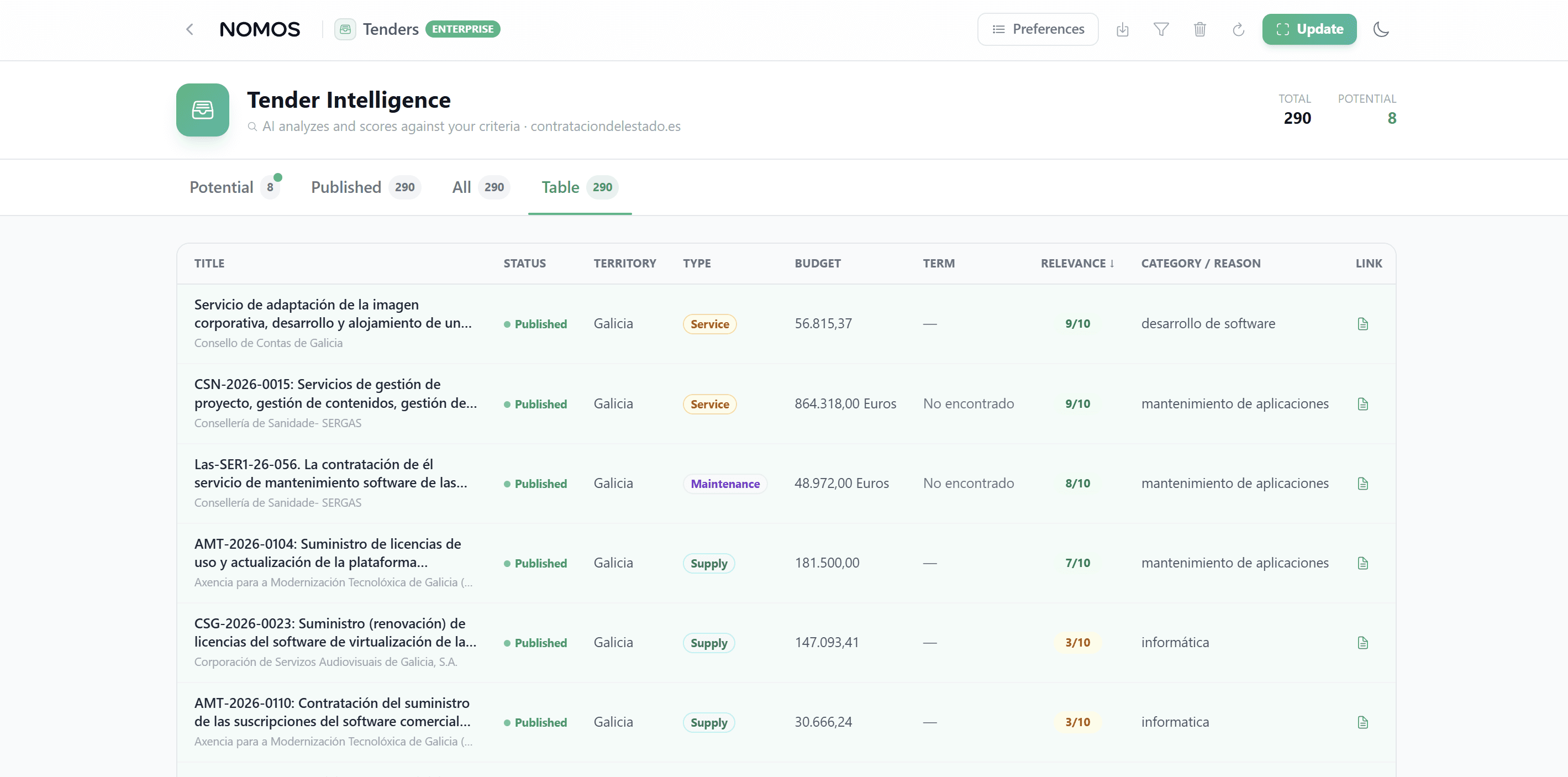
Nomos monitors the procurement portal in real time. For each relevant contract it downloads and analyses the PDF spec, assigning a 0–10 relevance score based on your criteria. You only see what matters.
Generate the technical proposal
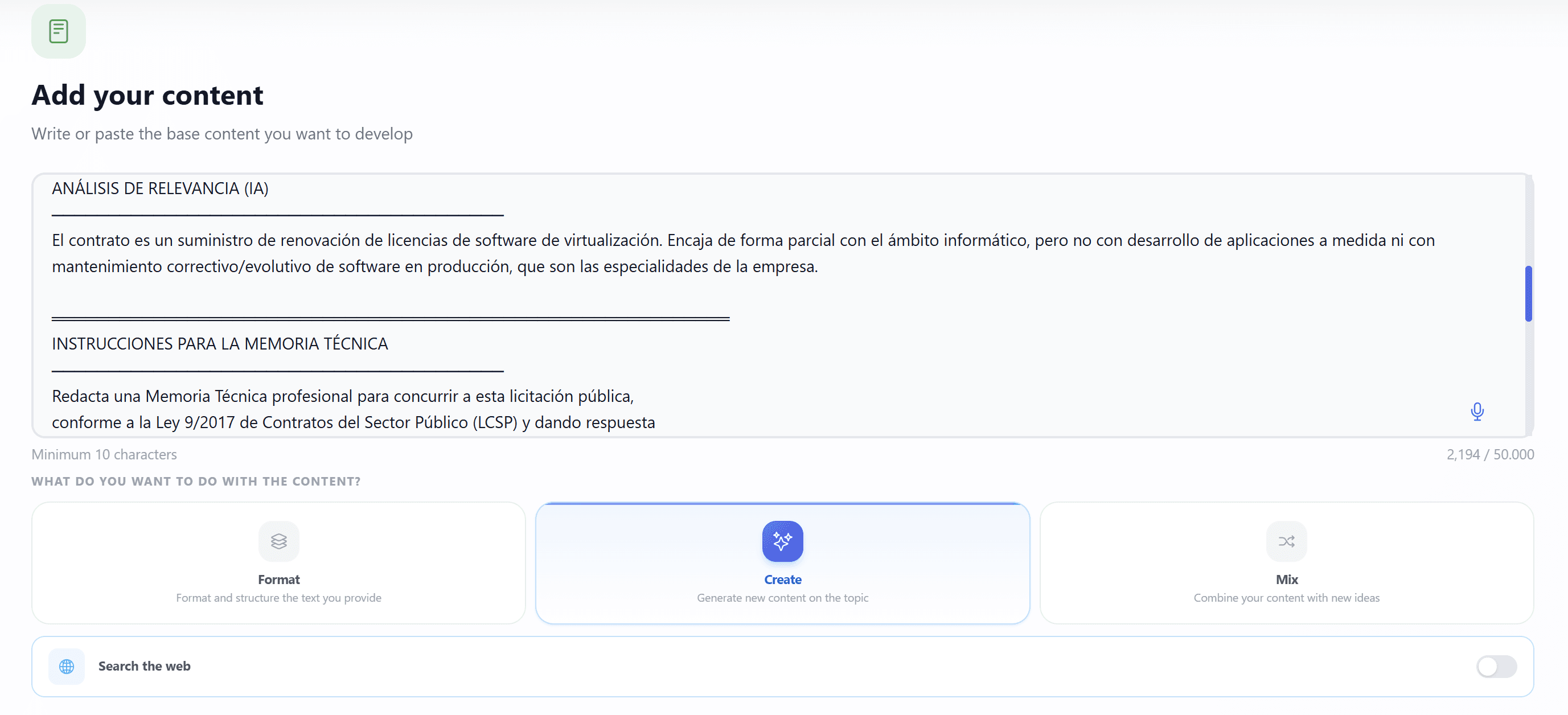
One click on any relevant contract generates the full technical proposal — eligibility, methodology, quality plan, value-adds — ready to sign and submit through the procurement portal.
From the tender radar to the technical proposal
Nomos scores every tender for relevance (0–10) by reading the full solicitation, then drafts the technical proposal from that analysis — not from a template.
Works for every type of contract
Nomos adapts the structure to the contract type and the evaluation rubric
Construction
Work plan, health & safety plan, quality control, schedule of works
Professional services
Methodology, technical team, milestone schedule, management plan
Maintenance & facilities
Preventive plan, response SLAs, spare parts, operational KPIs
Supplies
Technical datasheet, logistics plan, warranties, after-sales service
IT & consulting
Technical architecture, implementation plan, support, cybersecurity
Federal, state & local government
SAM.gov, FAR/DFARS clauses, SF-330, capability statements, NAICS alignment
Frequently Asked Questions
How does Nomos differ from Responsive (RFPIO), Loopio, or AutoRFP?
Enterprise RFP tools like Responsive, Loopio, and AutoRFP assume you already have a content library of approved answers and a proposal team to curate it. They help your team fill in answer fields faster. Nomos takes the opposite approach: drop in the raw RFP PDF and Nomos writes the full narrative proposal from scratch — no library, no proposal team required. It's built for consultancies, SMBs, and solo bidders, not 50-seat enterprise BD departments. Per-proposal pricing instead of $20-30K/year seat licensing.
What documents does Nomos generate exactly for an RFP response?
Full technical proposal with table of contents, quality assurance plan, value-added commitments, project execution plan, capability statements, past performance references, key personnel CVs, methodology, and — depending on the sector — health & safety plan or environmental management plan. All in one Word document with cover, pagination, and submission-ready formatting.
How does Nomos prevent my proposal from being generic?
Because it starts from the specific RFP, not a template. The AI reads the evaluation criteria of your specific procurement and builds the proposal answering point-by-point what evaluators will score. If you also upload past proposals as reference, it reuses verifiable data (past performance, team CVs, company info) adapting them to the new RFP.
Can I try it before paying?
Yes. Signup gives you 200 free credits with no card required. That's enough to generate a short proposal from a contained RFP. For a full 100-200 page proposal you'll need a credit pack (starting at €4.99). No mandatory monthly subscription.
What format does it export in, and can I sign it digitally?
It exports as editable Word (.docx). Once reviewed and validated by your team, you convert it to PDF and sign with your digital certificate before uploading to SAM.gov, e-Tendering, or the relevant procurement portal.
First time bidding? Read the complete guide on how to bid for government contracts from scratch
Want to understand the machine learning behind this tool? See how AI reads, scores and drafts your tender response
Your next tender win,
without searching or writing
No more manually trawling the procurement portal. No more writing 150 pages from scratch. No more paying a consultant thousands. Set up your preferences and let AI do the work.
Generate my proposal freeYou might also like
AI Technical Proposal Writer
Write the full technical proposal addressing every criterion
RFP PDF to Proposal
Upload the RFP PDF and get the proposal in Word
Free bid document analyzer
Extract criteria, budget and solvency from any tender document
How to bid on government contracts
Complete guide for SMEs starting to bid on public contracts
Automatic public tender search
Find tenders that match your company automatically